Now that we know the principles and pillars of the Red Urchin system, and what success must look like for highly effective people, we need to look at life as a whole.
We know the system must work in the real world, must be holistic, and must take in all of our tasks, strategies, goals, delegations and obligations. We also need to balance those competing inputs and then process, prioritise, schedule and complete them according to our pillars of effective time management.
Demands on our time come from many sources and, as we have said, any effective time management system must cover all of a user's life. It is critical to include not just work and personal inputs, but time for physical activity, learning, relationships, spiritual life and giving back.
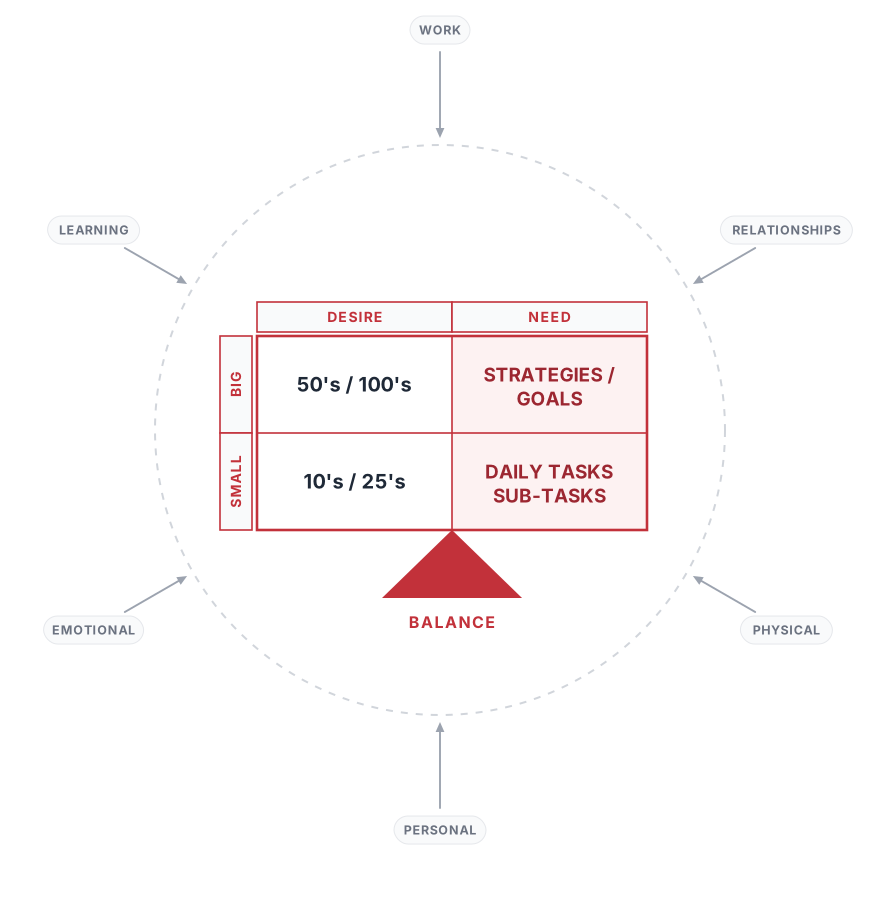
To make sense of this craziness, Red Urchin breaks your world into four key quadrants: first split by need and desire, then by big and small.
Need covers the things we have to do — to earn a living, to meet an obligation, and so on. In a perfect world you would not choose to "send the monthly sales report", but you need to do it, to earn an income, to live. Needs then break into two groups. The first is our activities: daily tasks and sub-tasks. These are the ones we are generally familiar with, the ones that take up most of our time (although perhaps they shouldn't) and make most of the noise in our day.
The second group is the bigger picture around those activities: our overarching strategies and goal objectives. Technically these can fall into both the desire and the need category ("I have a desire to learn photography by the end of the year"), and we treat them slightly differently on the desire side. Our goals and strategic objectives produce sub-tasks that combine to achieve the larger goal. These are normally the larger, bigger-picture items that people find hard to fit in between the bustle of daily tasks. This is exactly why we need a process that manages the daily tasks and noise and keeps us moving towards our strategic goals and objectives.
It is worth noting that need tasks can come from every area of life, not just work (going to the gym may be a need rather than a desire, depending on your point of view). Our need tasks generally consume most of our time and focus, which makes it all the more critical to balance them against our desire tasks. It is this balance that makes us happier and more content people. Remember our definition of success: it is not just about being more efficient, it is also about having (or creating) more time to do the things we enjoy. That is why we must balance need against desire.
Desire: 10s, 25s, 50s and 100s
Desire plays slightly differently in the Red Urchin ecosystem. Desire is driven by exactly that — desire. These are the things we want to do, for a variety of reasons, and we choose to do them. Desire tasks have two components: the tasks themselves and the reasons for doing them. Here we are going to cover the tasks. Red Urchin breaks desire tasks down using the work of Dr Fred Grosse, who first proposed classifying tasks by a person's drivers for happiness, fulfilment and satisfaction. They are very simply:
- 10s
- 25s
- 50s
- 100s
The tasks are grouped by their frequency in your life and their scale, but all are driven by the same outcome — "to make your soul smile". That outcome is the critical driver for these desire tasks. These are the tasks, activities and time that make you smile, that make your heart flutter. You know the feeling: that enveloping calm, that contentment, that warmth of love, that sense of pure achievement. This is what desire tasks are about, and we break them down into different levels.
To explain: a 10 is a type of task or activity you may do at least once a day (or perhaps two or three times a day). A 25 is one you may do once or twice a week. A 50 is something you may do for yourself once or twice a year, an overseas holiday, camping with the kids, going to a show. A 100 is something you do for someone else perhaps once a year or once in a lifetime,
It is a good idea to keep a list of your preferred 10s, 25s, 50s and 100s (this will be included in future versions of Red Urchin). Examples of 10s might be going to the gym (again, for some people this may be a need task), having a quiet coffee, reading a book for 15 minutes, or playing with your kids for 30 minutes. Examples of 25s might be having dinner with a friend, going for a walk on the beach, attending a class, or volunteering at a homeless shelter.
These tasks may be the sub-tasks of a larger strategy or goal that meets the desire criteria. For example, if you have a goal to learn Spanish by the end of the year, then one of your 25s might be to attend a Spanish class twice a week.
These activities are the key to balance in your life, and it is critically important that you schedule them into your planning — otherwise they will not get done. Lock the time in. They matter to you, they are your desires, and they are what make you happy.
Balance! It is the critical component of being a highly successful person. Before you can use the Red Urchin application effectively, you need all of your life inputs coming into it and you need balance between need and desire. We know from a great deal of real-world experience that when you achieve this balance you are not only highly effective, you also get to meet your desires — even if that is just a quiet coffee watching the world go by for 10 minutes a day. And that is a beautiful thing.
In the words of Dr Grosse, it "makes your soul smile" — and that is something we do not do enough.