Based on everything we have covered, it is now time to put it all together. The Red Urchin application plays a huge role in implementing our time and priority management system, but there are two further strategies that no application can capture for you.
To recap, we have covered:
- What success looks like for highly effective people (The Red Urchin System)
- Why you need a system to be highly effective (The Red Urchin System)
- What a system needs — its principles (The Red Urchin Principles)
- The processes we build the system on (Red Urchin Pillars)
- Ensuring balance exists, and why it is important (Red Urchin Balance)
Now, putting it all together to be highly effective humans, our world looks like this.
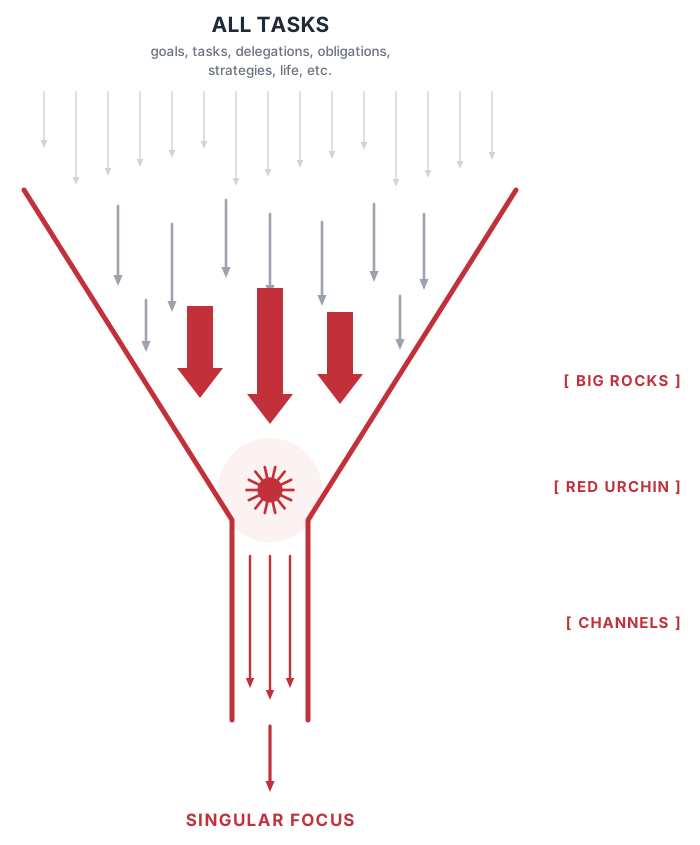
There are two key strategies that need to exist in the implementation layer of our time management ecosystem, and these are — drum roll, please —
- Big Rocks
- Channels
Big Rocks
The story behind this implementation strategy has been told many times in many different ways. Here it is as we first heard it, and as we use it in the Red Urchin system.
A Harvard professor (we are not sure why they are always from Harvard, or whether he was really a professor) stands in front of a lecture room full of students. On the table in front of him is an empty square glass fish tank about 1 metre (3 feet) wide. From under the table he lifts buckets full of rocks, each roughly the size of a grapefruit, and fills the tank with them. When he has finished, he asks the class, "Is the tank full?" The students confirm, more or less in unison, that it is.
The professor then takes another bucket from under the table. This one contains gravel, which he tips into the fish tank, filling it all the way to the top. Again he asks the class, "Is the tank full?" With a few laughs, the students agree that it now is. The professor lifts a third bucket from under the table, this time containing sand, and tips that in too. When it is filled to the top he asks, "Is the tank full?" By now the students are more than wary of answering yes.
The professor reaches under the table once more, retrieves a bucket of water and tips it into the tank, filling it to the brim. Smiling, he asks the class, "Is the tank now full?" The students warily reply that it is, and this time the professor agrees. "For all practical purposes, yes, the tank is now full. But what is the moral of the exercise?" After a while, a student answers, "That you can always fit more in?" "That is one of the lessons," the professor replies, "and a key principle of time management. But the greater lesson here is this: if you do not put the big rocks in first, you will never get them in at all."
And there you go — the first implementation strategy. If you track back to balancing your life and your tasks, and to balancing need against desire, the BIG part of both sections was strategies and goals (and the 10s, 25s, 50s and 100s). It translates simply: if you do not put the Big Rocks in first, you will never fit them in. If one of your 50s is to go scuba diving twice a year and you do not book it and lock it in, the noise and small tasks that consume your life will crowd it out. Take a smaller example: if you want to spend 30 minutes of quality time with your kids twice a week, put the big rock in place and build everything else around it, because if you do not put it in first you will never fit it in (sound familiar?). This is what happens to the vast majority of people. Even those who are fairly structured and good at time management forget this one critical implementation strategy.
Channels
This is also a simple concept, and one we could (and maybe will, in the future) dedicate multiple articles to. The principle is to achieve singular focus at all points in time. It sounds strange, but it drives two very important outcomes. First, it ensures you focus on and complete your designated task in the shortest possible time. Second, it ensures you are 100% present, in the moment. These two outcomes are different sides of the same coin, and it is the type of task that dictates which side you land on.
The principle comes from the idea of a remote control: you switch channels when you need to, just as you would on a TV, and you watch one channel at a time. It breaks down into two distinct working levels, both essential to the Red Urchin system and to the effective implementation of our time management principles.
From a high-level view, the channel principle is about being in the moment, and in the environment you are meant to be in. Say channel 2 is your work channel (the numbers are irrelevant), channel 8 is your home channel and channel 10 is your kids' channel. Between 6pm and 8pm you may be on channel 8, and for those two hours you are 100% dedicated to it. That means not slipping across to channel 2 to check email or take a phone call. Similarly, if 1pm to 2pm is your allocated time to complete a work task, you do not stop to talk to a co-worker about the weekend, and you do not let anyone interrupt you or switch your channel for you. So when you are at work you switch to channel 2, and you keep the weekend chat to a minimum. On channel 8 you switch off your phone and check it only at scheduled intervals. On channel 10, nothing disturbs your time: you are not thinking about anything else, because you have written everything down, and you are completely in the moment.
This achieves two very important goals: the first a life and balance goal, the second an efficiency goal. The life and balance goal is about being present in the moment. There is nothing worse, for you or for the people you are with, than not being 100% present. It takes practice and diligence over time to become proficient, but we know from experience that it is a critical piece of the balancing puzzle. Switch off your phone, your social media and the TV, be ruthless in applying this, and be present. It does not matter whether you are in a class learning or having dinner with a loved one — be there.
The second goal is simply ruthless efficiency, and it is particularly relevant to office and group environments. If you are at work, be at work and get your work tasks done. If you are reading, read. The office is where this is hardest: studies have shown over and over again how much time is lost there to unproductive activity. Look at the habits of highly effective, high-performing individuals (and we have) and a key behavioural trait is that they focus completely on the environment they are in. This means cutting short unfocused activities, closing your office door (or putting up a Do Not Disturb sign), and skipping the office birthday celebration. We know this has an impact on networking and social acceptance, but our goal here is effective time management rather than making more friends, so it is up to you to find the balance that works for you.
Our second, lower-level implementation of this strategy is reducing distractions. The single most important reason people do not achieve what they set out to achieve, even when they have planned and prioritised brilliantly, is distraction. Distractions cost you not only the time of the interruption itself, but also the time it takes to refocus and catch up to where you were on the task. Sometimes that is seconds; other times it is precious minutes. At this level, the concept of channels simply means focusing on what you need to do, for as long as you can, until it is completed. That means not constantly checking (or being alerted to) email, not answering your phone, and not being disturbed by whoever wanders past. This is difficult to achieve completely, but you can do it. Take small steps, ask the people close to you to remind you when you are crossing channels, reduce your distractions, and focus on what you need to be focused on.
These implementation strategies are critical to getting the most from the Red Urchin application. Follow the steps in the Red Urchin guides, built on the principles and strategies of the Red Urchin system, and you will achieve the success we outlined at the start. You will:
- Complete "everything" you need to get done in a given period
- Stop forgetting important, critical or promised tasks
- Achieve more in the same amount of time
- Use your available time more effectively
- Achieve the things you normally do not "have time for"
And you will do all of it with incredible balance and a real sense of achievement.